Commercial Wood Floor Restoration in Rochester, ME1
Commercial timber floors in Rochester work hard. School halls take chair legs, grit and sports traffic; restaurants and pubs deal with grease and cleaning chemicals; shops see constant heel traffic; churches and community buildings often have old boards that have been patched and repaired for generations. Once the protective finish starts wearing through, dirt gets into the grain, open joints collect debris and the floor becomes harder to clean safely.
We carry out commercial wood floor restoration near me in Rochester, ME1 for schools, churches, restaurants, shops, offices, community halls and other public-facing buildings. The work can include structural timber repairs, parquet re-bonding, controlled sanding, gap filling, staining, lacquering, oiling and planned maintenance rather than simply running a sanding machine over the surface and hoping for the best.
For facilities with floors already showing heavy wear, our Commercial Floor Restoration in Rochester service is planned around the condition of the timber and the operating hours of the building. We can also advise on Commercial Floor Maintenance in Rochester and appropriate Commercial Floor Polishing in Rochester where an existing coating can be mechanically cleaned, abraded and re-coated without taking the floor back to bare wood.
Rochester presents its own practical challenges. Properties around Rochester High Street, Eastgate, Castle Hill and the historic centre can include old floor structures, irregular subfloors and sensitive period fabric, while Victorian conversions and later institutional buildings elsewhere in ME1 often retain pitch pine boards, oak strip flooring or traditional parquet. Close to landmarks such as Rochester Cathedral, Rochester Castle, Eastgate House and the Guildhall, refurbishment work also needs to be carried out with considerably more care than would be expected on a modern empty shell.

Before-and-after herringbone parquet restoration comparison for commercial wood floor restoration services in Rochester ME1.
Commercial Timber Floors Fail Differently to Domestic Floors
A commercial floor can receive more wear in one working week than a lightly used sitting room sees in months. Dirt carried in from pavements acts as an abrasive, chair movement cuts through surface coatings, concentrated cleaning products attack lacquer films and rolling equipment can crush unsupported board edges.
This is why domestic-grade varnish and supermarket floor polish are rarely a sensible repair. Applying another shiny product over worn lacquer may make the floor look improved for a few days, but it does not correct poor adhesion, contaminated timber, loose parquet, moisture movement or a coating that has already worn through to bare wood.
- Loose parquet blocks: movement beneath foot can break old bitumen or brittle adhesive bonds and create raised edges.
- Open board joints: gaps hold grit, food debris and cleaning residue and can become hygiene problems in public buildings.
- Uneven timber: curled boards and high parquet blocks can create localised trip points.
- Moisture ingress: leaking pipework, wet cleaning and damp subfloors can cause cupping, adhesive failure and staining.
- Worn seal: once the coating is breached, timber absorbs moisture and contamination far more readily.
- Poor slip characteristics: incorrect polish or an unsuitable coating can alter wet and dry floor behaviour.
- Previous patch repairs: softwood infills, hard fillers and incompatible adhesives can move differently from the original timber.
- Heavy traffic lanes: entrances, serving areas, corridors and chair routes normally fail before the rest of the floor.
Our Commercial Wood Floor Restoration Process in Rochester
Step 1: Subfloor Audit, Timber Identification & Moisture Testing
Before sanding starts we establish what is actually beneath our feet. Quartersawn oak, pitch pine, teak, beech and reclaimed softwood all machine differently, and an old parquet floor cannot be treated in exactly the same way as 22 mm tongue-and-groove strip flooring.
We inspect loose boards, parquet movement, previous filler, damaged tongues, exposed fixings, perimeter expansion, suspect joists and changes in floor level. Where moisture is a concern, hygrometer readings and appropriate timber moisture checks are taken before deciding whether the floor is suitable for sanding or whether the cause of dampness needs attention first.
This is particularly important in older Rochester buildings where extensions, suspended timber floors and later concrete alterations may meet within the same room. Sanding a damp or unstable floor does not cure it; it simply leaves a cleaner version of the original defect.
Step 2: Timber Repairs, Re-Bonding & Resin Gap-Filling
Loose parquet is lifted only where necessary, old failed adhesive is cleaned back and blocks are re-bonded with a suitable flexible system. On compatible substrates we use modern silane-based flexible parquet adhesives, including low-emission products where an EC1 PLUS specification is required.
Damaged strip boards are repaired with matching or carefully selected reclaimed timber where practical. Loose nails and screws are dealt with before machine sanding so metal does not tear abrasive belts, throw sparks or damage the sanding drum.
For appropriate fine gaps, we make a resin-slurry filler using clean sanding dust taken from the floor, commonly after the intermediate sanding stage. Wider structural gaps normally need timber slivers or individual repairs rather than being packed with excessive resin, because a rigid mass of filler between boards that continue to move will eventually crack out.
Step 3: HEPA H14 Dust-Controlled Sanding & Surface Preparation
On larger commercial areas our main field sanding is normally undertaken with professional belt machinery such as the Lägler Hummel, connected to high-efficiency dust extraction. HEPA H14 filtration is particularly useful where we are working in schools, offices, healthcare-adjacent environments, restaurants or occupied buildings where dust migration has to be controlled properly.
A typical damaged commercial floor may begin around 36 grit to cut through degraded lacquer and flatten wear, followed by 60, 80 and progressively finer abrasives as the floor condition dictates. We do not jump from an aggressive cut directly to a finishing grade, because deep scratches left beneath a clear lacquer become painfully obvious once daylight travels across the completed floor.
Edges, corners, thresholds and radiator areas are worked separately and blended into the main field. The final preparation can include rotary buffing or multi-disc finishing at approximately 100-120 grit depending on the timber species, chosen coating and manufacturer’s system requirements.
Between stages we vacuum carefully rather than leaving abrasive debris on the floor. The object is an even, clean timber surface with a consistent scratch pattern, not simply pale-looking wood.

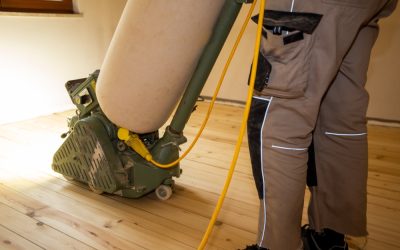
Parquet floor sanding in progress, illustrating the restoration process for commercial wood floors in Rochester ME1.
Step 4: High-Traffic Lacquers, Hardwax Oils & Slip Considerations
Commercial finishing has to suit the building rather than the photographs. A busy school corridor, restaurant floor and church nave have different cleaning regimes, traffic densities and expectations for repairability.
For heavily used floors we regularly specify professional 2K waterborne polyurethane lacquers. These systems use a separate cross-linking catalyst or hardener to develop a tougher cured film than ordinary single-pack domestic varnish, while quality modern systems keep solvent and odour levels considerably lower than traditional solvent-heavy coatings.
Products such as Bona Traffic HD, LOBA 2K systems or equivalent commercial-grade coatings can be considered according to substrate, required sheen, cleaning regime and occupancy. Matt and satin finishes are generally more forgiving in commercial spaces than a high-gloss film, which can advertise every scratch and maintenance mark.
Hardwax oil remains useful where clients want a lower-build appearance or easier localised maintenance, but it needs the correct ongoing cleaning programme. An oiled floor that is repeatedly washed with aggressive alkaline detergent will deteriorate much faster than one maintained with compatible products.
Slip performance must also be treated as a safety issue rather than a marketing phrase. Where formal slip-resistance assessment is specified, the current UK framework includes BS EN 16165 and the pendulum test method; older specifications may still refer to BS 7976-2. We can work with a client’s flooring consultant, facilities team or independent slip-testing specialist where measured Pendulum Test Values are required.
Coating selection is recorded within the method statement, and associated products are reviewed under COSHH requirements. Low-VOC and low-emission systems are preferred wherever they are technically suitable, particularly in education, hospitality and public buildings that need to return to use quickly.
Step 5: Cure Times, Reopening & Planned Floor Maintenance
A floor being dry to touch does not mean the coating has reached full chemical cure. Reopening is therefore planned around the actual finish specification, room temperature, ventilation and site conditions rather than an arbitrary promise that everything will be ready first thing the following morning.
Many professional 2K waterborne systems permit cautious pedestrian access after the initial cure period, but furniture replacement, mats, heavy equipment and wet cleaning may require longer. We provide the site contact with practical handover instructions so a newly finished floor is not damaged on its first day back in service.
Good maintenance normally means dry soil removal, correctly diluted neutral cleaner and inspection of high-wear areas before they reach bare timber. A periodic clean, machine abrasion and maintenance coat is far less disruptive than repeatedly allowing the original finish to wear away and carrying out a full re-sand.
If you want to see the type of timber floors we work on, visit our floor restoration gallery. For an indication of typical sanding costs before arranging a survey, see our floor sanding prices.
Out-of-Hours Commercial Floor Sanding in Rochester
Commercial restoration is often won or lost on logistics. We regularly plan work around opening hours, deliveries, cleaners, school timetables, worship services and other trades rather than assuming the building will simply close until we finish.
Before work begins we agree access routes, extraction positioning, electrical requirements, work zones and the point at which each area has to be handed back. RAMS documentation and COSHH information can be supplied for commercial sites, and working areas can be isolated to reduce interaction between contractors, staff and members of the public.
| Working Arrangement | Operational Benefit | Typical Facility Suitability |
|---|---|---|
| Overnight Working | Heavy sanding and preparation completed after normal trading, reducing interference with customers and staff. | Restaurants, shops, offices, hotels, reception areas and busy commercial premises. |
| Weekend Phased Works | Allows larger sections to be completed with additional curing time before Monday occupation. | Schools, offices, clinics, public buildings and commercial halls. |
| Sectional Restoration | Keeps part of a large building operational while controlled work zones are restored individually. | Community centres, schools, churches, corridors, halls and larger venues. |

Before-and-after hall timber floor comparison showcasing commercial wood floor restoration services in Rochester ME1.
Commercial Floor Restoration for Rochester Schools, Churches, Shops & Venues
Schools and education buildings usually require hard-wearing lacquers, sensible holiday scheduling and careful control of airborne dust. Assembly halls and teaching spaces also need close inspection around chair storage routes, entrances and areas used for events.
Churches and historic buildings can contain old pine, oak blocks and repairs from several different periods. Our priority is to retain sound historic material where possible rather than replacing character timber simply because its colour or dimensions are not perfectly uniform.
Restaurants, pubs and hospitality venues bring grease, spillages and concentrated cleaning into the specification. Coating compatibility, hygiene, slip behaviour and the time available before the room has to return to service all matter as much as appearance.
Retail shops and offices often require overnight or phased programmes. Entrances and walkways tend to wear first, so we also assess whether a full sand is genuinely required or whether a professional abrasion and re-coat programme can extend the existing finish.
RAMS, COSHH & Commercial Site Control
A commercial quotation needs more information than room dimensions. We consider access, isolation, electrical supply, waste handling, fire routes, neighbouring occupied areas, lifting requirements and where sanding equipment and HEPA extraction can be operated safely.
Site-specific Risk Assessments and Method Statements (RAMS) can cover machine operation, manual handling, dust control, electrical equipment, coatings and restricted work areas. Relevant finishing products, fillers, cleaners and adhesives are covered by appropriate COSHH assessments and manufacturers’ technical data.
Where a principal contractor or facilities manager requires it, operative information and CSCS details can be supplied as part of pre-start documentation. Suitable commercial liability insurance is maintained for professional work in occupied and public-facing premises.
A Proper Commercial Quote Starts With the Floor, Not a Guess
For an initial assessment, send clear photographs or a short video showing the full floor, damaged areas, entrances and any loose boards or parquet. Floor plans and approximate square metre measurements are also useful when we are working out likely labour, machine access and phasing.
For larger Rochester projects we recommend a physical site survey before agreeing the final specification. That visit allows us to identify timber species, inspect previous coatings, check local repairs, discuss moisture concerns and establish exactly when each working section can be released to our team.
The quotation can then separate necessary restoration from optional work. If a maintenance re-coat will do the job, we would rather specify that correctly than remove several millimetres of valuable timber unnecessarily.
Why Commercial Clients Use an Experienced Timber Floor Team
- Commercial timber and parquet restoration rather than domestic-only sanding.
- Lägler Hummel professional belt sanding equipment.
- HEPA H14 dust-control arrangements for sensitive occupied sites.
- Quartersawn oak, pitch pine, teak, beech and parquet identification.
- Silane-based flexible parquet re-bonding systems.
- Resin-slurry filling, timber slivers and individual board repairs.
- 2K waterborne polyurethane and commercial hardwax-oil specifications.
- COSHH assessments and site-specific RAMS where required.
- Out-of-hours, weekend and sectional work programmes.
- CSCS-carded operatives where required by site rules.
- Commercial liability insurance.
- Photo/video assessment followed by physical surveys for larger contracts.

Arrange a Commercial Floor Survey in Rochester
If your school hall, church, restaurant, shop, office or commercial timber floor in Rochester ME1 is worn, loose, difficult to clean or down to bare timber, send us photographs, a short video and any available floor plans. We can give you an initial view of the likely restoration work before arranging a site inspection where required.
Call 0800 335 7565 to discuss access, floor condition, out-of-hours working and your required completion date. You can also send site photographs or floor plans via WhatsApp or email when making your enquiry so we can assess the project before the survey.
Request your Rochester commercial floor restoration assessment