School Floor Sanding in Rochester, ME1
School floor sanding in Rochester, ME1 is rarely just a case of taking a machine across a tired hall and putting a coat of lacquer down. In schools and education buildings we regularly deal with worn traffic lanes, failed seals around entrances, chemical damage from incorrect cleaning products, loose parquet blocks, open board joints and timber that has been patched several times over the years.
Those defects become more than cosmetic once dirt starts lodging in open joints or a polished surface becomes difficult to clean properly. In classrooms, corridors, assembly halls, dining areas and sports spaces, the restored floor has to be hygienic, structurally sound, slip-conscious and fit-for-purpose when pupils and staff return.
We provide School Floor Restoration in Rochester, planned School Floor maintenance in Rochester and full School Floor Refinishing in Rochester for nurseries, primary and secondary schools, academies, colleges, universities, training centres and other education premises throughout ME1 and the surrounding Medway area.
Rochester has a particularly mixed building stock. Around the historic High Street, Rochester Cathedral, Rochester Castle, The Vines and St Margaret’s Street there are Georgian and Victorian properties alongside later educational buildings, while elsewhere in ME1 we encounter Victorian conversions, Edwardian institutional blocks and more modern teaching accommodation.

Before and after school floor sanding in Rochester, ME1, showcasing the restoration of worn solid timber floorboards in a school classroom.
Why School Timber Floors Wear Differently
A school floor takes punishment that a normal domestic floor simply does not see. Hundreds of shoes can cross the same doorway each day, chair legs are dragged repeatedly over classrooms, grit enters from playgrounds, sports equipment is moved across halls and cleaning teams may wash the surface every evening.
Once the original lacquer or oil film breaks down, dirt and cleaning solution can penetrate the grain. A glossy maintenance polish can temporarily disguise the damage, but it cannot repair a fractured coating, stabilise loose parquet or remove contamination that has worked into bare timber.
Domestic sanding methods are also poorly suited to an occupied educational site. Dust escaping into adjoining rooms, uncontrolled solvent use, trailing leads across escape routes or a finish chosen without considering cure time and slip performance can create more problems than the sanding solves.
- Open board and parquet joints: collect grit, food debris and cleaning residue and may create small trip or hygiene traps.
- Loose parquet blocks: can rock under load, break surrounding tongues and progressively damage neighbouring areas.
- Worn lacquer: leaves exposed timber vulnerable to water, ink, paint, sanitiser and cleaning chemicals.
- Entrance moisture: can cause local swelling, staining, adhesive failure and dimensional movement.
- Over-polished surfaces: may produce inconsistent grip, particularly where water is tracked in during wet weather.
- Repeated aggressive sanding: can reduce the service life of older boards and parquet by unnecessarily removing sound timber.
- Historic repairs: may conceal incompatible fillers, bitumen residues, nails, screws or replacement timber of a different density.
Our Commercial School Floor Restoration Process
Every school project is assessed as a working building rather than an empty room. Access, safeguarding, fire routes, noise, dust migration, drying conditions and the time available before the area has to reopen all influence the specification.
Step 1: Subfloor Audit & Moisture Testing
We start by identifying the floor construction and timber species. Rochester schools can contain anything from narrow pitch pine boards and quartersawn oak strip flooring to herringbone parquet, finger block flooring and occasional teak or other dense hardwood installations.
The survey checks for loose boards, deflection, damaged tongues, hollow parquet, perimeter movement, historic filler, protruding fixings and previous coating systems. We also look closely around external doors, radiators, plumbing routes, kitchens, wash areas and ground-floor walls where moisture problems tend to make themselves known first.
Where there is any doubt over damp, the floor is tested rather than simply sanded and sealed. Depending on the construction, that may include calibrated timber moisture-meter readings and hygrometer checks to establish whether the substrate conditions are suitable for repair, adhesive work and coating.
A damp timber floor should not simply be trapped beneath a new film finish. If readings indicate an active moisture problem, the source has to be investigated before refinishing proceeds.
Step 2: Timber Repairs, Re-Bonding & Resin Gap-Filling
Loose parquet is lifted carefully where required, old friable adhesive is removed and individual blocks are re-bonded once the substrate has been assessed. On suitable projects we use modern silane-based flexible parquet adhesives because they offer strong bonding while retaining a degree of elasticity as the timber moves.
Missing or badly damaged sections are repaired with timber selected for species, grain direction and thickness rather than simply fitting whatever board happens to be available. On an old pitch pine hall, for example, a pale modern softwood patch can stand out badly once the floor is sanded.
Fine stable gaps can often be filled using a resin-slurry method, mixing compatible resin filler with clean sanding dust produced from the floor. This gives a much more sympathetic colour than generic decorators’ filler and sands flush with the surrounding timber.
We do not blindly pack every gap. Expansion margins, moving joints and excessively wide seasonal gaps have to be treated according to their cause, otherwise a rigid filler can crack out or restrict the natural movement of the floor.
Step 3: HEPA Dust-Controlled Sanding & Surface Preparation
For substantial areas we use professional belt sanding equipment such as the Lägler Hummel, supported by edging and finishing machinery appropriate to the floor. The abrasive sequence is chosen after inspecting the coating thickness and floor flatness rather than starting unnecessarily coarse.
A badly cupped boarded floor, for instance, needs a different approach from an otherwise flat parquet floor carrying only a tired surface coating. On parquet we also have to respect the changing grain direction of the blocks; poor sanding technique can leave cross-grain scratches that become far more obvious after the first coat is applied.
Commercial dust control is equally important. Our sanding set-up uses high-efficiency extraction with HEPA H14 filtration where specified so airborne fine dust is controlled at source rather than allowed to migrate into classrooms, computer rooms, libraries or ventilation routes.
Edges, corners, thresholds and radiator areas are brought through the appropriate abrasive grades before final vacuuming. The floor is then inspected under working light so swirl marks, chatter, filler defects and isolated contamination are dealt with before any primer, oil or lacquer reaches the surface.

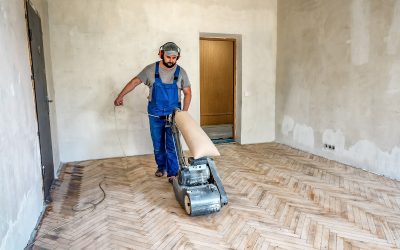
Professional wood floor sanding for school floors in Rochester, ME1.
Step 4: High-Traffic Finishes for School Floors
The finish specification depends on how the room is used. A reception corridor, music room, classroom, assembly hall and sports space do not necessarily require the same coating, even when the underlying timber is identical.
For high-traffic education interiors we commonly specify professional 2K waterborne polyurethane lacquer systems. These use cross-linking chemistry to produce considerably better resistance to abrasion and chemicals than light-duty domestic varnishes, while modern waterborne systems also reduce odour and solvent loading during application.
Where appropriate, systems such as Bona professional floor finishes can be considered for demanding commercial timber floors. Product choice, primer compatibility, number of coats and permitted return-to-service period are confirmed against the current technical data sheet rather than assumed from previous jobs.
For floors where an oil system is preferable, we may consider a hardwax oil such as Osmo Polyx-Oil. Hardwax oils give a different appearance and maintenance regime from lacquer, so we discuss future cleaning and localised repair requirements before specifying them for a school.
Slip resistance also has to be treated as a specification issue, not a marketing phrase. Where a client requires formal verification, pendulum testing can be arranged and the required performance agreed within the project documentation.
Many existing school and facilities-management specifications still refer to BS 7976-2 Pendulum Slip Resistance. BS 7976-2 has since been withdrawn, so where formal certification is required we establish the applicable current test method and project requirement, including BS EN 16165 Annex C where appropriate, rather than copying an outdated reference onto a completion sheet.
For areas with an elevated slip risk we can assess compatible anti-slip lacquer systems or additives. The coating still needs to remain practically cleanable; creating an excessively aggressive surface in the pursuit of grip can make routine school cleaning unnecessarily difficult.
Low-VOC Materials, COSHH & Indoor Air Quality
Schools require tighter control of products than many unoccupied commercial premises. Before work starts, relevant primers, fillers, adhesives, cleaning products and finishes are reviewed through the project COSHH assessment, with Safety Data Sheets retained as part of the site documentation where required.
Low-emission systems are preferred wherever they are technically suitable. Products carrying an EMICODE EC1 Plus rating can be useful when the brief calls for particularly low indoor emissions, although certification never replaces correct ventilation and curing.
Two-component products also require disciplined mixing. A cross-linking catalyst has a defined ratio and pot life; adding extra hardener does not make the lacquer stronger and can compromise application and film performance.
Step 5: Aftercare & School Floor Maintenance
The restored floor is only as good as the maintenance regime that follows it. One of the most common causes of premature coating failure is the routine use of inappropriate detergents, strong alkaline cleaners or repeated polish applications that leave a sacrificial film over the manufacturer’s finish.
We provide a practical cleaning and maintenance schedule matched to the installed system. That normally covers dry grit removal, approved damp-cleaning products, dilution rates, entrance matting, dealing with spillages and when a maintenance clean or screen-and-recoat should be considered.
Chair and desk feet also deserve attention. Grit trapped beneath a damaged chair glide can cut through a lacquer far faster than normal foot traffic, leaving hundreds of identical scratches across an otherwise sound classroom floor.
For examples of previous restoration work, visit our floor sanding gallery. For an indication of typical costs before arranging a survey, see our floor sanding prices.
Planning School Floor Sanding Around Active Facilities
A technically good floor restoration can still be a badly managed project if it interferes with teaching, safeguarding or reopening dates. Before mobilisation we agree access points, storage areas, working zones, isolations and the sequence in which rooms will be returned to the school.
For occupied sites this is usually documented through RAMS covering sanding equipment, electrical leads, manual handling, dust control, coatings, restricted areas and other site-specific hazards. Where several contractors are operating during holiday works, sequencing is especially important; freshly coated floors and electricians carrying access towers through the same corridor are not a useful combination.
| Working Pattern | Operational Benefit | Typical Facility Suitability |
|---|---|---|
| Overnight Working | Allows sanding or preparation to take place after pupils and staff leave, reducing disruption to teaching and circulation routes. | Tuition centres, colleges, universities, administrative areas and facilities where secure night access is available. |
| Weekend Phased Works | Provides a longer uninterrupted working and drying window while keeping weekday operations largely intact. | Primary and secondary schools, academies, language schools, training centres and childcare facilities. |
| Sectional / Zoned Working | Keeps part of a large floor or building operational while individual zones are repaired, sanded and coated in sequence. | Large campuses, boarding schools, universities, colleges and education buildings with multiple access routes. |

Before and after school hall floor sanding and restoration in Rochester ME1. Herringbone parquet flooring professionally sanded and refinished to restore its natural warmth and shine.
Cure Times and Returning the Floor to Service
Dry is not the same as cured. A coating may be safe for controlled light foot traffic well before it has developed its full resistance to furniture movement, cleaning chemicals, wheeled equipment or heavy use.
That distinction is particularly important during half-term and summer works. We programme final coats backwards from the required handover date and check the manufacturer’s current temperature, humidity, recoating and cure requirements before agreeing when furniture can be returned.
Cool buildings and high relative humidity can slow waterborne coatings substantially. If a caretaker is expecting to close the hall at 5pm and reopen it for assembly at 8am the following morning, that requirement has to be discussed before the finish is specified rather than discovered after application.
School Halls, Classrooms, Corridors and Specialist Teaching Areas
Assembly halls often suffer concentrated wear at entrances, beneath stacked seating and along routes used to move staging or PE equipment. Older parquet halls may also have previous line markings, repairs and deeply ingrained maintenance polish that need to be dealt with during preparation.
Classroom floors usually show different damage: chair-leg scratching, ink and paint staining, localised water damage around sinks and pronounced traffic lanes between desks and doors. Where only the upper finish is worn, a maintenance recoat may sometimes be more sensible than another full sand.
Corridors and circulation areas see the highest repeated footfall and the largest amount of grit carried in from outside. These are areas where entrance matting, cleaning method, coating durability and sensible slip performance all need to work together.
Nurseries, preschools and childcare rooms need particularly careful planning because children spend more time close to the floor. Dust management, low-emission products, curing time and cleaning compatibility therefore carry significant weight in the specification.
Education Premises We Work With
Our commercial timber floor service is suitable for a broad range of education and childcare environments across Rochester and the wider Medway area. The process is adjusted to suit the building, floor construction, safeguarding requirements and available shutdown period.
- Nurseries, preschools, kindergartens and daycare centres
- Primary, elementary and secondary schools
- High schools, academies and sixth-form colleges
- Private, public and independent schools
- Boarding and international schools
- Special education and Montessori schools
- Colleges, universities and higher education institutions
- Vocational training centres and technical institutes
- Tuition centres and tutoring academies
- Language, music and art schools
- Sports academies and multi-purpose education halls
- Adult learning centres and educational training facilities
- After-school clubs and childcare centres
- Multi-building educational campuses
Older School Buildings in Rochester, ME1
Working in Rochester’s older buildings requires a little restraint. Floors close to the historic core may have been repaired, covered and refinished numerous times, and taking another heavy cut simply because the sanding machine is capable of it can remove timber that cannot be put back.
A Victorian conversion near the High Street or The Vines can contain original softwood boards alongside later hardwood repairs, while institutional buildings may contain thick oak or parquet designed for decades of use. We establish the floor’s condition first and remove only what is necessary to obtain a sound, consistent surface.
Access can also be tighter around Rochester’s historic streets than on a modern campus. Delivery times, parking restrictions, machine movement and extraction equipment therefore form part of the site planning rather than being left until the first morning of the project.
Why Proper Preparation Costs Less Than Repeated Quick Fixes
A school can spend considerable money polishing a floor whose underlying coating has already failed. The result may look better for several weeks while the timber underneath continues absorbing contamination and the surface becomes progressively harder to restore cleanly.
Good restoration separates structural repair from cosmetic treatment. Loose blocks are dealt with before sanding, moisture is checked before adhesive is applied, the timber is sanded to the correct abrasive finish and the coating is selected for actual traffic rather than simply for its initial shine.
That approach also preserves more of the original floor. With planned cleaning and timely maintenance coats, a sound commercial timber floor can often be kept in service without repeatedly sanding back to bare wood.
Commercial Site Documentation and Accountability
School projects normally need more paperwork than residential sanding, and rightly so. Our commercial teams can operate with CSCS-carded staff, appropriate commercial liability insurance and site-specific documentation including RAMS and COSHH information where required by the school, principal contractor or facilities manager.
We keep the quotation process straightforward. An initial assessment can usually begin from clear photographs, short videos, approximate dimensions and any available floor plans; for larger, damaged or technically uncertain floors we then arrange a physical site survey before finalising the specification.
The quotation sets out the intended repair work, sanding process, finish system and any assumptions that affect the price. If we find moisture problems, widespread loose parquet or unsuitable historic coatings during inspection, those points are raised before the project starts rather than hidden inside a vague sanding allowance.

Planning School Floor Works in Rochester, ME1?
Call 0800 335 7565 to discuss the floor, available shutdown period and required reopening date. If you already have site photographs, videos or floor plans, send them by WhatsApp or email so we can review the condition before arranging the survey.
Tell us whether the floor is in a classroom, corridor, school hall, sports area or other teaching space, together with any known problems such as loose parquet, exposed timber, water staining or previous coating failure. That information helps us establish the correct restoration route from the outset.